

Why Gameplay Animators Who Work on Their Poses First Progress Faster

In gameplay animation, we often talk about cycles, attacks, transitions, timing... In short, everything that moves fast and makes noise.
But animators who progress the fastest have one very simple thing in common: they work on their poses before everything else.
They're not trying to create a perfect image. They're trying to establish a clear intent.
Because in production, a good pose is worth ten hours of polish. And often, ten fewer rounds of revisions.
A clear pose is the most powerful tool for understanding, and making others understand, what the character is really trying to do.
It's a discreet superpower: it accelerates your progression, streamlines communication, reduces feedback rounds, clarifies choices... and instantly makes you more reliable in a team.
It's a skill we often underestimate, yet it's the one that changes everything.
Before we go any further
You won’t find ultra‑stylized, artbook‑worthy poses here.
There are already plenty of excellent resources online for that.
What I’m going to show you are working poses , the ones we use every day, in real production contexts, to move things forward.
They respond first to gameplay constraints, not aesthetic criteria, and they’re built to communicate quickly and reliably with the team.
Appeal and refinement come later ,but readability has to be there from the very beginning.
The Pose : Your #1 Communication Tool
In gameplay, a pose isn't a frozen image. It's a message. A real one.
It tells:
What the character wants to do
Where their intent lies
How they're preparing
What the player needs to understand in a fraction of a second
When the pose is readable, the decision is clear. When it's confusing, doubt spreads, and in production, doubt is contagious.
Animators who progress quickly have understood this: they use the pose to think, to choose, to communicate.
Before even thinking about animating, they set the framework. And everything else becomes simpler.

Two Approaches, Two Results
Imagine two animators working on a boss attack.
Animator A: Sends a complete playblast: 60 frames, motion blur, FX, the whole package.
The lead watches, squints: "I don't understand where the hit is. The anticipation is unclear. Redo it."
Three days of work... back to square one.
It's frustrating, discouraging, and above all, avoidable.
Animator B: Sends three fixed poses. Just three.
Anticipation—clear tension
Impact—maximum extension, obvious contact point
Recovery—readable weight and direction
The lead validates in two minutes.
Animation can begin, peacefully.
The difference?
Animator B communicated their intent before investing time.
They used the pose as a decision tool, not as an aesthetic prerequisite.
And this is often where juniors get trapped: They invest enormous amounts of time in an animation that ultimately doesn't respond to the initial intent.
Not because they lack talent, but because they haven't yet developed the reflex to lock down the pose before diving in.
And this methodology is crucial in production when working as a team: it avoids misunderstandings, unnecessary feedback, and weeks lost correcting an intent that could have been clarified in three images.
Once integrated, progression becomes very logical:
Clear poses → Fast validations → Lead's confidence → More autonomy → More complex projects → Accelerated progression
It's about clarity.
Why It Changes Everything in Production
When a pose is clear, everyone saves time. Literally everyone.
The game designer immediately understands the intent.
The tech animator sees the movement logic.
The VFX artist knows where to place their impact.
The level designer visualizes the timing.
And the lead doesn't need to guess what you wanted to do.
A readable pose reduces feedback, avoids misunderstandings, and accelerates validations.
It's one of the most powerful levers for becoming a reliable animator, the one people call when things need to be done fast and well.
In production, clarity is a superpower.
We work through iteration, we move forward together, and every unclear intent slows down the entire chain.
A well-thought-out pose, on the other hand, immediately aligns all disciplines.
Readability in Real Conditions
Prince of Persia: Clarifying a Complex Mechanic Through Poses
On Prince of Persia: The Lost Crown, I worked on complex enemies whose attacks played out... backward in time.
Early on, we even tested the idea of them moving backward too.
After a few tries, we quickly realized that "rewind" locomotion mostly gave the impression that the enemy was sliding on the ground like a living bug.
Not ideal for readability.
So we kept only the reversed attacks , and that's where poses became essential.
With this particularity, readability was non-negotiable: if the player didn't understand what they were seeing, they thought the animation was bugged.
To avoid this, instead of sending the complete animation, we started by aligning 5 key frames with the game designer:
Idle
Recovery becoming anticipation (we're backward in time...)
Hit (too late to dodge)
Windup (player must react here)
Anticipation becoming recovery (punishment window)
In a few minutes, we knew what worked, what needed adjustment, and how to structure the mechanic before diving into complex animations.
Because these poses didn't show "a beautiful anim."
They communicated the desired gameplay, clearly, unambiguously.

Ghost Recon: Function Before Aesthetics
On Ghost Recon, readability wasn't an artistic choice. It was tactical.
The player needed to instantly understand:
Who is ally/enemy
The state (alert, rest, patrol)
The threat level
Each pose had to transmit this information unambiguously. It didn't need to be "cool" or "stylish", it needed to be useful.
We tested our poses directly in the engine, in real conditions: from far away, up close, in movement, in shadow, in full light... in short, in all situations where the player had to make a decision in a fraction of a second.
And that's where we touch on something essential: if the silhouette wasn't immediately recognizable, the game's difficulty skyrocketed.
The player could no longer anticipate the right behavior, and everything became unfair, not because of the AI, but because the animation wasn't giving the right information.
That's why we talk about systems.
A gameplay animation never exists alone: it's part of a set of mechanics, distances, timings, feedbacks.
And in this set, the pose is the first filter.
It's what tells the player: "here's what's happening, here's what you need to understand."

A complementary perspective — Jérémy Trilles (Dojo Créatif)
To enrich this vision, I really appreciate the way Jérémy Trilles, 3D animator and mentor at Dojo Créatif, summarizes the importance of posing in the learning process of animation.He reminds us that posing is not just a technical step, but a true visual language that structures the entire movement.
Why is posing an essential step for improving in keyframe animation?
Animation is a sequence of poses. The famous Key Poses.
Just like in comics or manga, they can stand on their own and still convey the action.
The artist pays attention to every tiny detail, like a sculptor, from the position of the fingers to the silhouette of the clothing.
This attention to detail is what makes the image appealing to the viewer.


Whether in video games or film, posing is an art in itself.
I evaluate it through three criteria:
Readability
Credibility
Dynamism
Readability → the player must quickly understand what the character is doing and how they’re doing it.
Credibility → the pose must be consistent with the character’s traits and the game’s level of realism.
Dynamism → the aesthetic punch that grabs the viewer, the “wow” effect. It often involves exaggerating reality, pushing the body, and playing with camera focal length.
For me, posing is the foundation of a successful animation.Without carefully sculpted poses, the animation loses impact for the player.
Look at how the poses in God of War are exaggerated despite the realistic art direction.Without this meticulous posing work, Kratos’ attacks would feel far less powerful.
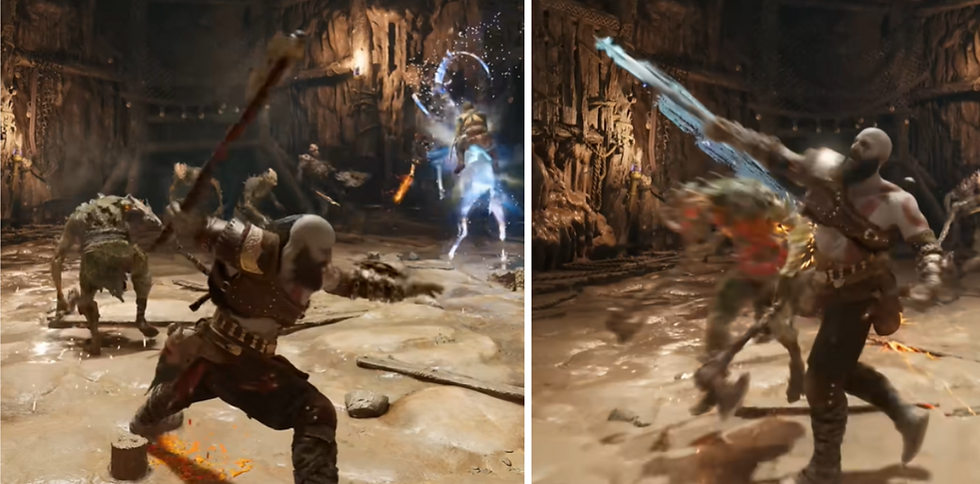
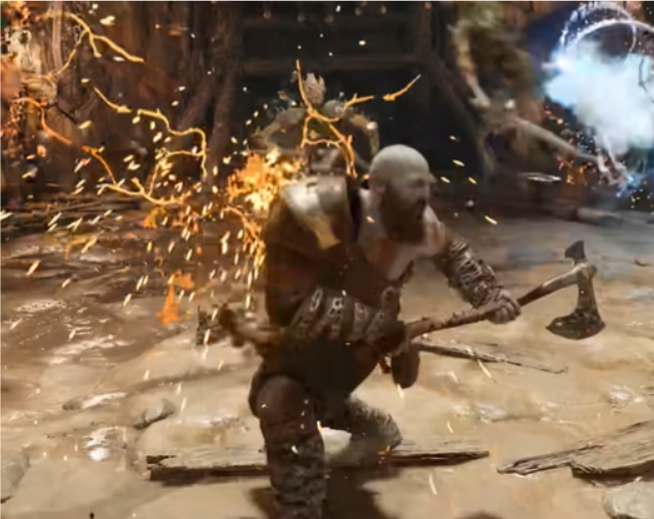
My own animations drastically improved when I started reproducing poses from my favorite mangaka, such as Yusuke Murata (One Punch Man) and Masashi Kishimoto (Naruto).


Posing for an animation blocking can take hours, depending on whether the poses need to work in 360° or from a specific camera angle.
But once these poses are validated by the team (anticipation, impact, and other extremes), more than 50% of the work is already done.
Because the direction of the movement, the force, and the physical storytelling are already decided.
The rest is just a matter of timing/spacing and the in‑betweens that connect those solid key poses.
So dear animators, don’t neglect posing if you want to level up your animation skills.
Recreate poses that inspire you, using every feature of your chosen rig to achieve a result that grabs the viewer.
Do isolated exercises if needed:
10 hand poses, with and without objects
10 facial expression poses
10 full‑body poses
10 key poses from the same movement, minimizing counter‑animation and already anticipating the spline pass
You’ll see the difference :)
Thanks to Jérémy Trilles for this complementary insight.
You can discover his work and resources here: Dojo Créatif.
WHAT A GOOD POSE REVEALS ABOUT AN ANIMATOR'S MATURITY
A readable pose reveals a way of thinking, an understanding of gameplay, and true mastery of priorities.
Behind a good pose, there are always deep skills.
1. The Ability to Make Choices
A clear pose doesn't try to show everything. It emphasizes where information needs to be transmitted.
Where to concentrate energy
Where to simplify
Where to exaggerate
Where to remove what parasites
Juniors often try to make everything visible at once.
Experienced animators know what needs to be read first, and what can stay in the background.

2. Understanding Gameplay
A gameplay pose is a signal. It must transmit what the player needs to understand immediately:
An attack must telegraph its timing.
A dodge must indicate its direction and range.
A charge must show its intent before the movement even begins.
When a pose is designed for gameplay, it becomes an element of the system, not just a 3D drawing.

3. Visual Hierarchy
A good pose organizes information. It says: "Look here first, then there, then there."
In a combat pose, for example:
Primary: attack direction (weapon, arm, line of action)
Secondary: body weight (legs, torso, balance)
Tertiary: details (fingers, accessories, hair)
The animator hierarchizes to guide the eye.

4. Intent
A pose is a decision. It must answer a simple question: Why is the character making this movement?
Without intent, the pose is empty. With intent, the character exists, even frozen.
When the pose makes the character exist to the point where the player forgets the animation, embodiment surpasses technique and the animator signs their true know-how.

5. Character Consistency
The pose must reflect their personality, role, and how they should be perceived by the player.
A tank and an assassin don't pose the same way. Even for an identical action, their poses tell two different stories.
The pose then becomes a mirror: it immediately shows how the animator conceives their character, and to what extent they understand their role in gameplay.

🚩Red Flags to Avoid
Understanding the pose also means understanding what sabotages it.
Here are the traps I find most often:
❌ Trying to show everything at once → A pose that tells ten things tells none.
❌ Prioritizing "cool" before readability → If the player doesn't understand the intent, style is useless.
❌ Adding details to "fill" → Detail isn't information. It can even drown it.
❌ Forgetting the player → A pose designed for the showreel, not for gameplay, is immediately obvious.
❌ Ignoring the character's role → A pose that reflects neither the archetype nor the function creates immediate dissonance.
❌ Confusing movement and intent → A pose can be technically correct while being narratively empty.
These red flags are reading errors, intent errors.
They show that the animator hasn't yet understood why the pose is essential.
HOW THIS SKILL ACCELERATES A CAREER
The Virtuous Circle
Clarity doesn't just save time. It changes how a team perceives you.
An animator who poses clearly becomes someone:
Who can be entrusted with entire mechanics
Who secures the game designer's decisions
Who streamlines exchanges between disciplines
Who reduces the risk of misunderstandings in production
Who becomes a support point for leads
Who understands the player as much as the movement
At this stage, the pose is more than an animation tool. It's a leadership tool.
It structures, clarifies, guides.
And that's exactly what advances a career.
a clear synthesis of all the reflexes that help you think like a senior gameplay animator.
CONCLUSION
Working on your poses isn't going back to a school exercise.
It's developing the skill that makes the difference between an animator who executes... and a reliable animator who understands, chooses, and communicates.
ameplay animators who progress quickly aren't trying to go faster. They're trying to be more readable.
And everything else follows: technique, speed, confidence, responsibilities.
Last month, you defined who your character is. This month, you're discovering why making that identity readable changes everything.
Ask yourself a simple question: "Do my poses communicate as clearly as my intent would like?"
If the answer is no, you know exactly where to start.
And that's exactly what this month's challenge invites you to strengthen: taking the time to explore gameplay poses before deciding how your character moves.
This challenge is the second in a cycle of 12 themes, each designed to develop an essential gameplay pillar, and, along the way, the skills that truly accelerate an animator's career.
Share your poses on the AniMotion Discord: https://discord.gg/ZBgbhmEvUj
When did you understand the importance of poses in production, or conversely, what headache could have been avoided with a better initial pose?


Comments