Interview Farhanaz Kassee‑Elahee Walking, Storytelling, Animation


Building a gameplay walk means dealing with a set of constraints that go far beyond simple locomotion: transitions, interruptions, readability, weight, intention, system coherence…
This April, AniMotion takes a closer look at this movement , one that is essential to the feeling of control.
To deepen the discussion, I’m joined by Farhanaz Kassee‑Elahee, animator and studio director at Purple Meadows, whose hybrid background brings a sensitive perspective on how a character truly “exists” through their walk.

Your career path is quite unique. How did you go from Disney to Ubisoft, and eventually to founding your own studio?
My career path is mostly a series of opportunities. I didn’t really plan it — I was “lucky” in some ways, and I also had the nerve to knock on doors without being afraid.
I come from a background that isn’t privileged and not artistic at all, so I had very few role models. I spent most of my high‑school years alone in museums, and very early on I knew I wanted to move toward an artistic field.
I studied one year at the Beaux‑Arts in Marseille, then completed a Cinema degree at Paris 8, followed by a Master’s in Visual Design at CNAM‑ENJMIN.
After my studies, I took a chance and went to work in animation studios.
My first job was as an animator on a Disney TV series, and I learned an enormous amount.
When you have more than 70 retakes and around thirty rounds of feedback, when everyone has gone over your shots because a few frames don’t please the team in the US, there’s no better school.
The animation rules were literally taped to the walls all the way up to the ceiling.
Then I applied directly to Ubisoft for a AAA project , this time in 3D, with mocap.
I learned a lot there too, progressed quickly, and even led teams. My only issue is that I don’t like stagnation: once I feel I’ve gone around the cycle, I need to move on to something else.
I moved back to Angoulême and applied to animation studios working on 2D series. I should mention that I’m self‑taught in animation , I never studied it in a dedicated program. And yet I’ve worked, and still work, on animation projects.
I even specialized in semi‑traditional animation.
I wanted to create my own game studio because I couldn’t find productions in Angoulême that really spoke to me, and I felt it was the right moment.
I wanted to make a project that brought together everything I love: animation, interactivity, and storytelling.
From the start, I received writing support from the CNC, and then I was selected for the Villa Albertine residency in New York.
So I jumped into this adventure, put a lot of energy into making it real, and I’m quite proud of it.
You’ve moved through very different worlds : 2D, 3D, character design, art direction, poetry, even founding a studio. What’s the common thread that ties all of this together for you?
Narration is always the core for me, with emotion as the guiding thread. I can’t create anything if it doesn’t tell a story.
I need to experiment, and I need things to feel new.
It’s true that I do a lot of different things, but in reality everything revolves around how I can express a story and convey emotions.
So I choose the mediums I love , the ones that allow me to explore and shape those narratives.

You’re also a poet and a writer. Does that sensitivity to rhythm, words, and raw emotion influence the way you think about a gesture or a movement?
Absolutely.
I actually write before I draw , I’m constantly writing in my head.
Drawing and movement are very instinctive for me.
I’ve been dancing since I was 16 and playing music since I was 13.
Animation is, in many ways, a matter of rhythm and movement.
It’s the same with writing. I studied screenwriting, and I’m completely unable to write without imagining the movements, the rhythm, even the sound of the words.
I think everything influences everything else, in its own way.
You’ve worked in both character design and animation. Does one influence the way you approach the other?
Yes , it’s actually essential.
I’m very lucky because I work on projects where I need to adapt the character designs to make them animatable.
Depending on the animation technique, I adjust the design, and I can even shape them in my own style, which is a real luxury.
Usually, you have to adapt to someone else’s style.
This allows me to fully characterize the characters and do real acting work.
I think a lot about simplifying the designs so I can animate them without spending thousands of hours on each shot, so I do a huge amount of research to draw inspiration from everywhere and make sure the character is understandable at a glance.
I anticipate the animation by thinking about the rigging (even in 2D), and I design accordingly.
Of course, it also depends on the budget and the schedule.

When you moved into real‑time animation on Ghost Recon, what did you learn there that you wouldn’t have discovered anywhere else?
It’s a tricky question, because I feel that every project is different , each production has its own specificities and constraints.
But it was the only time I worked on such a large‑scale production with such a big team, and that was incredibly enriching.
I also learned a lot from my colleagues.
I had the opportunity to work on the main character, on NPCs, on cinematics, and even to do some acting direction during mocap shoots.
A truly wonderful experience.
As a studio director, does your animator’s eye still play a role in your creative decisions?
My animator’s eye is now simply my eye.
I can’t look at anything without analyzing it , even when I watch people, I’m constantly drawing inspiration from everything around me.
At Purple Meadows, our studio, I approach everything with that mindset.
I anticipate, I think ahead, and I make decisions through that lens , and it’s one of our strengths, even if it’s an expensive one.
A small anecdote: a friend thought we had animated every single scene in our demo , which is absolutely not the case, we cheat a lot.
But it made me happy that he had that impression, because that’s exactly what I’m aiming for: making the images feel alive.
In an indie context, what do you absolutely protect in animation, and what can be simplified?
I’m becoming more and more passionate about interactive animation.
I see so many beautiful animation projects ( short films, feature films, video games ) and they inspire me a lot.
I do quite a bit of R&D to develop my own techniques.
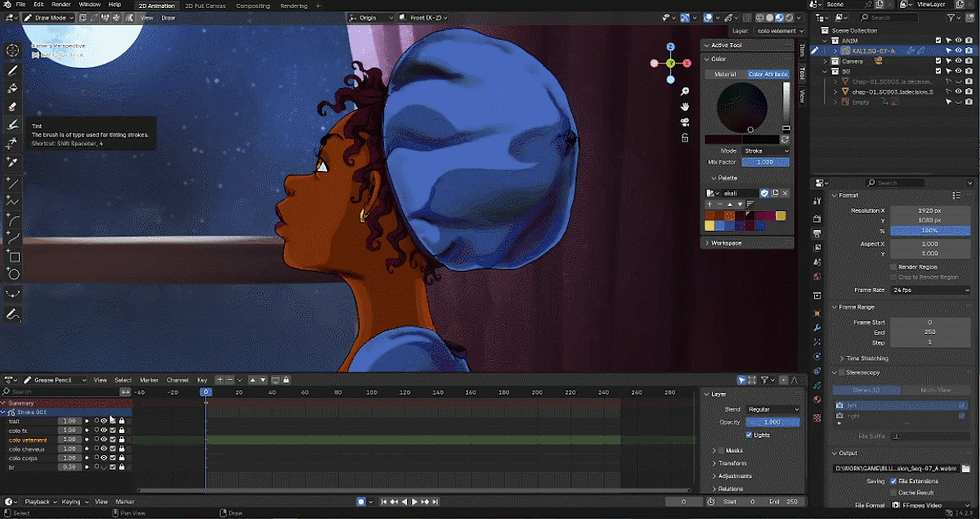
I want to develop my own “visual signature”, which is how I ended up working with Grease Pencil in 2.5D (a mix between 2D and 3D), because I simply can’t make games the way you’d make feature films. It’s just not possible.
So I found a compromise by drawing on all the techniques I’ve learned (traditional, cut‑out, custom rigs, etc.).
I mix all of that to simplify the animation process while keeping a certain level of quality. It’s what allows me to get closer to that “animated” feel.

On Blue Bird’s Song, how do you balance artistic vision and animation? When beauty and playability collide, who gets the final say?
I like to say that what we’re doing on Blue Bird’s Song is a kind of direction that feels almost like lacework : delicate, precise, and full of tiny details.
When I have ideas, I create video edits to show what I have in mind, and then I check with the programmer (and sometimes even with the composer) to see whether it’s possible and how we can make it work technically, especially because of the interactivity.
For me, emotion comes first.
Players shouldn’t notice any separation between gameplay, story, or anything else. We make sure everything feels fluid and immersive , the narrative has to sit at the heart of the action and pull players into a captivating story. For me, gameplay is in service of the narrative.
Do Disney’s 12 principles really apply to video games, or do they need to be reinterpreted for gameplay?
They absolutely apply , but they need to be adapted so those principles work within interactivity.
In the end, it’s all magic anyway. It’s always about perception.
It’s never a perfect reproduction of reality, just the feeling of reality.
Is there a common mistake that animators coming from film tend to make when they switch to gameplay?
Oh yes , they tend to create animations that feel a bit soft, because they put in far too many frames.
The spacing/timing relationship is different in real‑time, and they also need to learn how to animate in place, while not forgetting weight and all the secondary animations.
Do you have an anecdote where a constraint led to a solution that turned out better than expected?
On a trailer I directed, I had to create several groups of layers to give the impression of an explosion.
I’ll admit I tinkered and hacked things together to get that effect, and in the end it worked really well , even though I hadn’t managed to storyboard it the way I wanted beforehand.
Sometimes you just need to experiment and let “happy accidents” happen, and they can work like magic.
And it’s also true that I’ve made animations I personally found so‑so, but that ended up working incredibly well in real time.
Walking is one of the animations players see the most in a game. In your opinion, what makes a walk work in gameplay — not just technically, but in terms of what the player feels?
A walk gives indirect information about the character, the world, and the gameplay.
I think it’s essential to really think about how it’s characterized to strengthen immersion , without harming playability.
It’s usually something you build together with the programmer and the whole team , the game designer, the sound designer, etc.
Because everything contributes to that feeling of fluidity, immersion, and enjoyment.
A walk can reveal a character’s inner state. How do you play with that?
For the main character, we don’t have a huge amount of freedom, because the animations serve both gameplay and narrative.
It’s a bit like being an actor , you follow the director’s vision , and in games, that role is usually taken by the game director.
Of course, you can add lots of little details to reveal a character’s inner state: shaking their head, scratching their head, talking, and so on.
Depending on the game, you can add more or fewer of these touches.
But the way you approach a character’s emotional states is very different from film, because you always have to consider the player.
You need a whole set of subtle cues that help convey the message.
What differences do you see between a walk designed for a film and a walk designed for a game?
The main difference is interactivity (or real‑time).
In a film, you’re completely free under the direction of a single director , that’s basically the only constraint.
In a game, everything is a constraint: timing, all the animations that can be played or interrupted at any moment (a jump, a run, a stop, even sitting down, etc.).
It’s really a different way of thinking about animation, through what we call an animation graph , a kind of diagram showing all the animations and how they connect.
Even if the fundamentals of animation are roughly the same, it’s not quite the same job.
Many animators struggle with these constraints when they move into video games.

Has there ever been a walk , in a game, a film, a series, or even just someone in the street , that stopped you in your tracks, and why?
There are so many , it’s something I genuinely love observing.
When I was little, in Disney films, I adored Belle in Beauty and the Beast, because her walk shows her perseverance and determination.
And Pocahontas too, for the same reasons, and also because it was one of the first times I saw a heroine who looked like me.
I also think of all the characters in Miyazaki’s Howl’s Moving Castle, who truly moved me. Their walks are conceived as narrative elements , every character walks and moves differently.
And in Samuel by Émilie Tronche, the characters have a vibe I absolutely love.
The animation is incredible , and the director is also a dancer, which shows.
The main character in the game Gris by Nomada Studio moves as if the shapes were pigments blending into water , it’s absolutely stunning.
And the characters in Mumrik: The Melody of the Moominvalley, made in 2.5D , a technique I adore and that’s executed beautifully.
The common thread is really the emotion I felt, and still feel, when I watch them. It moves me. When characters are embodied like that, it’s so touching.
It makes a world believable, and the characters feel like they truly exist. It’s poetry, or magic , very hard to explain.
To finish, could you share a piece of advice, a technique, or an approach you would specifically recommend to game‑animation artists? Something you wish you had known earlier in your career, or an important lesson you’ve learned.
My advice is to keep experimenting and to analyze what you enjoy.
But above all, have fun. The more joy you put into your work, the more it reaches the audience.
For pre‑rendered animation, many people , especially early in their careers , tend to overwork and do unpaid overtime in animation studios.
Don’t do that. It’s hard to build confidence, but it’s important to take care of yourself and the profession so everyone can work in good conditions.
For real‑time animation, don’t be afraid to talk to people from all the other disciplines. It can feel intimidating, but it’s essential if you want to produce high‑quality work.
Explore, experiment, don’t be afraid to get involved.
And sometimes, dare to assert yourself , because unfortunately, animation isn’t always seen as a priority.
I still see this in game‑dev schools: very few students choose this path.
What I wish I had known earlier in my career is that impostor syndrome is something you learn to live with.
And even if you didn’t follow the “right” training path, it doesn’t mean you can’t make it.
For a long time, I didn’t tell people I was self‑taught. Now I see it as a real strength, because I’m not afraid to learn and I adapt quite easily.
Thank you so much for this interview!
A huge thank‑you to Farhanaz for the generosity of her answers.
What stands out above all is the space she gives to emotion, instinct, and the joy of creating. She speaks from the heart, and it resonates strongly in a field where technique often takes center stage.
This interview is a reminder that gameplay animation is a passion‑driven craft , and that this passion deserves to be protected.
In a domain where we often talk about gameplay animation through the lens of graphs, constraints, and systems, her perspective offers a rare breath of fresh air. She reminds us that behind every movement, every walk, every intention, there is a person who observes, feels, doubts, experiments, and moves forward.
This interview feels good because it reconnects animation with what made us all start in the first place: the desire to tell stories, to bring things to life, to convey something.
A precious perspective for anyone trying to find their place in a demanding, sometimes intimidating, but deeply human profession.
If you want to learn more about Farhanaz’s work, you can find her profile here:


Comments